

Australians have $4.5 trillion in superannuation. It is the fourth biggest retirement pool in the world. Every year, $34 billion is taken out in fees. That is more than the government spends on the Age Pension. A 0.5 per cent fee difference can cost you $200,000 by retirement. Industry funds charge less than retail funds. The gap can be 0.5 per cent. That sounds small. Over 40 years it is not. OnePath has been the worst performer for seven years in a row. ASIC fined AustralianSuper $27 million for overcharging members. Cbus was fined $23.5 million for delaying death benefit claims. The penalties come from fund reserves. That means members pay for their own fund's mistakes.
$34 billion. That is how much Australians paid in superannuation fees in 2024-25. The government spent $23 billion on the entire Age Pension system in the same period. Workers’ compulsory retirement savings generated more in fees than the pension cost the budget. (Source: Rainmaker Information, October 2025; Grattan Institute)
Australia’s superannuation pool reached $4.5 trillion in December 2025. It is the fourth largest private pension system in the world. It exceeds 150 per cent of Australia’s GDP. (Source: APRA, February 2026; Deutsche Bank, October 2025)
The Fee You Do Not See
The industry-wide Total Expense Ratio fell to 0.86 per cent in 2025. That was the sixth consecutive year of decline. Fees are coming down. They are still high enough to devastate retirement balances through compounding. (Source: Rainmaker Information, October 2025)
A difference of 0.5 per cent in annual fees sounds trivial. Over a 40-year working life, it can strip $100,000 to $200,000 from a retirement balance. A typical Australian will pay approximately $233,000 in super fees over their lifetime. (Source: Productivity Commission 2018; ASIC Moneysmart; Rainmaker, October 2022)
The trap is sharpest at retirement. Retirees pay 55 per cent of their lifetime super fees during the retirement phase. Their balances are largest and the compounding damage is greatest. (Source: Rainmaker, October 2022)
Workers’ compulsory retirement savings generated more in fees than the pension cost the budget.
Industry vs Retail
Industry funds, which are profit-for-member, typically charge 0.5 to 0.7 per cent in total fees. Retail funds, which are for-profit, charge 0.97 per cent or more. The gap has narrowed from 1.7 per cent in late 2021 to under 1 per cent recently. But it still exists. Over a career, it still compounds. (Source: SuperGuide, April 2025; Super Review)
Industry funds grew market share from 38.2 per cent to 40 per cent in FY24. They attracted $62 billion in net inflows over 12 months to September 2025. (Source: KPMG Super Insights 2025; Wealth Data)
Hostplus Balanced returned 8.7 per cent per annum over 10 years. AustralianSuper Balanced returned 8.21 per cent. These are strong returns. They do not change the fact that $34 billion was extracted in fees. (Source: SuperRatings, January 2026)
The Worst Performers
OnePath, owned by ANZ, has been named the worst-performing super company in Australia for seven consecutive years. Colonial First State, AMP, and ClearView each have multiple “fat cat” products. Approximately $7 billion sits in the 40 worst funds, costing more than $120 million in excess fees annually. (Source: Stockspot Fat Cat Funds Report; Investor Daily)
The APRA performance test, introduced in 2021, has driven improvement. In its first year, 13 MySuper products failed. By 2024 and 2025, zero failed. The test is working as a deterrent. Whether it is too easy is debated. Morningstar and others have questioned whether funds use rebates and other mechanisms to pass rather than genuinely improve. (Source: APRA, August 2025; Morningstar, March 2026)
When Regulators Bite
ASIC secured $349.8 million in court-ordered civil penalties in the second half of 2025. The highest six-monthly total in its history. Superannuation was a key focus. (Source: ASIC REP 829, February 2026)
AustralianSuper was fined $27 million in February 2025 for failing to merge approximately 90,700 duplicate member accounts over nearly a decade. Members were overcharged by almost $35 million in unnecessary fees. Staff knew about the overcharging years before it was reported. (Source: ASIC Media Release 25-017MR)
In March 2025, ASIC sued AustralianSuper again over delayed processing of nearly 7,000 death benefit claims. Some families waited up to four years. (Source: ASIC)
Cbus was ordered to pay $23.5 million in November 2025 for systemic failures in processing members’ death benefits and insurance claims. The fund’s chair is Wayne Swan, a former federal Treasurer. (Source: ASIC Media Release 25-286MR)
Here is the problem with these penalties. They are paid from fund reserves. That means members ultimately bear the cost of their own trustee’s misconduct. The Financial Accountability Regime, extended to super funds in 2025, is designed to make individuals accountable. In practice, penalties still flow from the fund. (Source: Investment Magazine, March 2025)
The Revolving Door
Helen Rowell was APRA’s Deputy Chair until June 2023. She joined the Australian Retirement Trust board in March 2024. She was appointed Chair in October 2025. ART is the second-largest super fund in the country. She now chairs the entity she used to regulate. There is no legislative barrier to this. (Source: Investment Magazine, October 2025)
Greg Combet was ACTU secretary, then a Labor minister, then chair of IFM Investors, then a trustee of AustralianSuper. In January 2024, he was appointed Chair of the Future Fund, Australia’s $225 billion sovereign wealth fund, by Treasurer Jim Chalmers. (Source: Treasury Ministers Media Release, January 2024)
Peter Costello, a former Liberal Treasurer, chaired the Future Fund for 14 years from 2009 to 2024. He established the Future Fund as Treasurer, then was appointed to run it. (Source: Future Fund)
Wayne Byres, former APRA Chair, joined the Macquarie Bank board in 2024. (Source: Macquarie Group)
The Political Influence Question
Industry Super Australia received approximately $24 million from member funds for lobbying activities. AustralianSuper, Hostplus, HESTA, and Cbus paid a combined $24.9 million to ISA in a single financial year. (Source: AFR, December 2023; Senator Jacqui Lambie, 2023)
APRA admitted that the structures around ISA and Industry Fund Services “precluded” the regulator from tracking whether industry funds make political donations. A Freedom of Information request revealed internal government notes saying officials had asked the funds, “they say they do not” make political donations. This was not independently verified. (Source: Money Management; PMC FOI document)
In September 2022, the Labor government backflipped on a plan to remove requirements for super funds to disclose itemised political donations, after pushback from transparency advocates. (Source: AFR, September 2022)
The structural concern is that compulsory worker savings are being used to fund industry lobbying through ISA. Workers do not vote on this spending. Trustees decide. Members pay.
The Other Side
The super industry makes legitimate arguments. Fees have fallen for six consecutive years. The system delivers good macro outcomes. Australia’s Age Pension costs just 2.3 per cent of GDP, far less than most OECD countries. The super system reduces government pension liabilities.
Industry funds’ access to infrastructure, private equity, and unlisted assets has delivered strong returns. Active management adds value. The McKell Institute argues that fee comparisons with other countries are methodologically flawed. (Source: McKell Institute; ASFA)
The Your Future Your Super reforms are working. From 1 million members in failed products in 2021 to 8,500 in 2025. Payday Super, starting July 2026, will address unpaid super affecting an estimated 3.3 million workers. (Source: ATO; Treasury)
These arguments have merit. They do not change the fundamental arithmetic. $34 billion a year is being extracted from workers’ compulsory retirement savings. That is the number.
The Way Forward
Expand the APRA performance test beyond MySuper to cover all “choice” products. Millions of Australians are in products that have never been tested. (Source: Productivity Commission 2018)
Require annual member fee statements showing lifetime fees paid and projected impact. Most Australians do not know what they pay.
Consider a hard fee cap on default products. The Netherlands and other countries use fee caps in their pension systems.
Address the penalty paradox. Penalties for trustee misconduct should be borne by trustees, not member reserves.
Implement a meaningful cooling-off period for senior regulators moving to industry board positions. The Helen Rowell appointment, from APRA Deputy Chair to ART Chair in nine months, demonstrates the gap.
Require full transparency on ISA spending. If $24 million a year from member savings is going to industry lobbying, members should know and should have a say.
The system is not broken. It is extracting too much from the people it was designed to serve.
Sources
- APRA Super Statistics Dec 2025: https://www.apra.gov.au/news-and-publications/apra-releases-superannuation-statistics-for-december-2025
- Rainmaker Fees Report: https://www.rainmaker.com.au/media-release/superannuation-fees-fall-again
- Grattan Super Savings: https://grattan.edu.au/report/super-savings/
- Productivity Commission 2018: https://www.pc.gov.au/inquiries-and-research/superannuation/assessment/report/
- ASIC AustralianSuper Penalty: https://asic.gov.au/about-asic/news-centre/find-a-media-release/2025-releases/25-017mr-australiansuper-fined-27-million-after-asic-investigation-into-failing-to-merge-multiple-superannuation-accounts/
- ASIC Cbus Penalty: https://asic.gov.au/about-asic/news-centre/find-a-media-release/2025-releases/25-286mr-cbus-ordered-to-pay-23-5-million-penalty-for-serious-failures-in-processing-members-death-benefits-and-insurance-claims/
- ASIC REP 829: https://download.asic.gov.au/media/mr4fa4kt/rep-829-published-25-february-2026.pdf
- KPMG Super Insights 2025: https://kpmg.com/au/en/insights/industry/australian-superannuation-industry-insights-analysis.html
- AFR Political Donations: https://www.afr.com/politics/labor-backflips-on-super-fund-political-donations-20220902-p5bex6
- McKell Institute: https://mckellinstitute.org.au/research/articles/debunking-super-myths-2-australias-fees-are-too-high-by-international-standards/
- Treasury Retirement Income Review: https://treasury.gov.au/sites/default/files/2021-02/p2020-100554-udcomplete-report.pdf
- Stockspot Fat Cat: https://www.stockspot.com.au/fatcat/
Related Investigations
Public Cost, Private Profit / Political Capture
190,000 Households Wait for Public Housing. 370 Homes Were Delivered.
190,000 households wait for public housing. The government promised 40,000 homes and delivered 370. Property investor tax breaks will cost $247 billion.
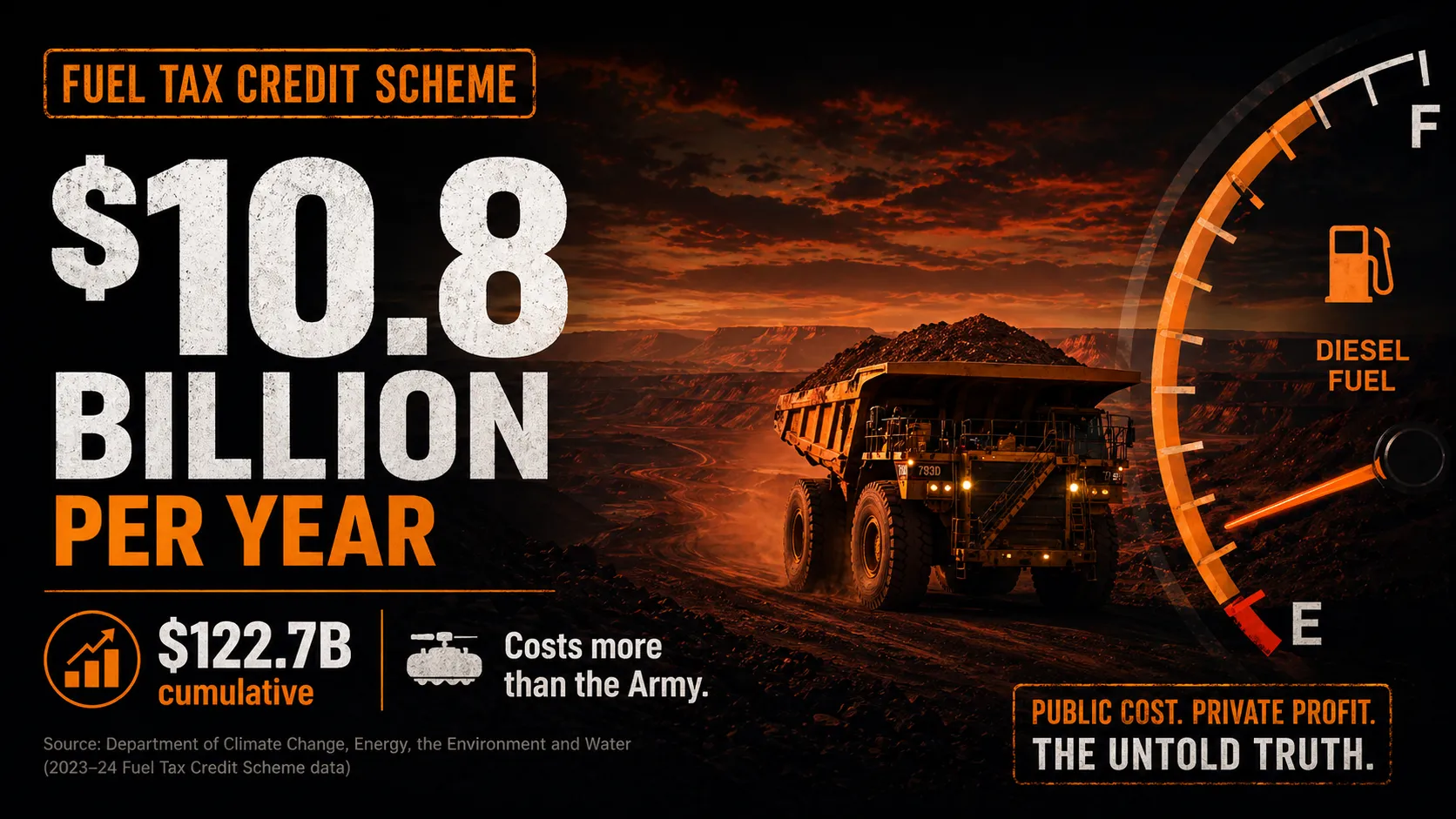
The $10.8 Billion Rebate
The Fuel Tax Credit Scheme hands back $10.8 billion a year to companies that burn diesel off-road. Mining takes roughly half. The cumulative bill is $122.7 billion. That is more than the Australian Army costs. One Rio Tinto executive lobbied the Treasurer personally to keep it. Eighty-six per cent of Australian mining is foreign-owned. The rebate flows to shareholders overseas. Australians pay foreign companies to dig up their own dirt.
The Donation Pipeline
Fossil fuel companies donated $3.98 million to Australia's two major political parties in a single financial year. The Coalition got $2.92 million. Labor got $1.06 million. Both got enough to notice.