
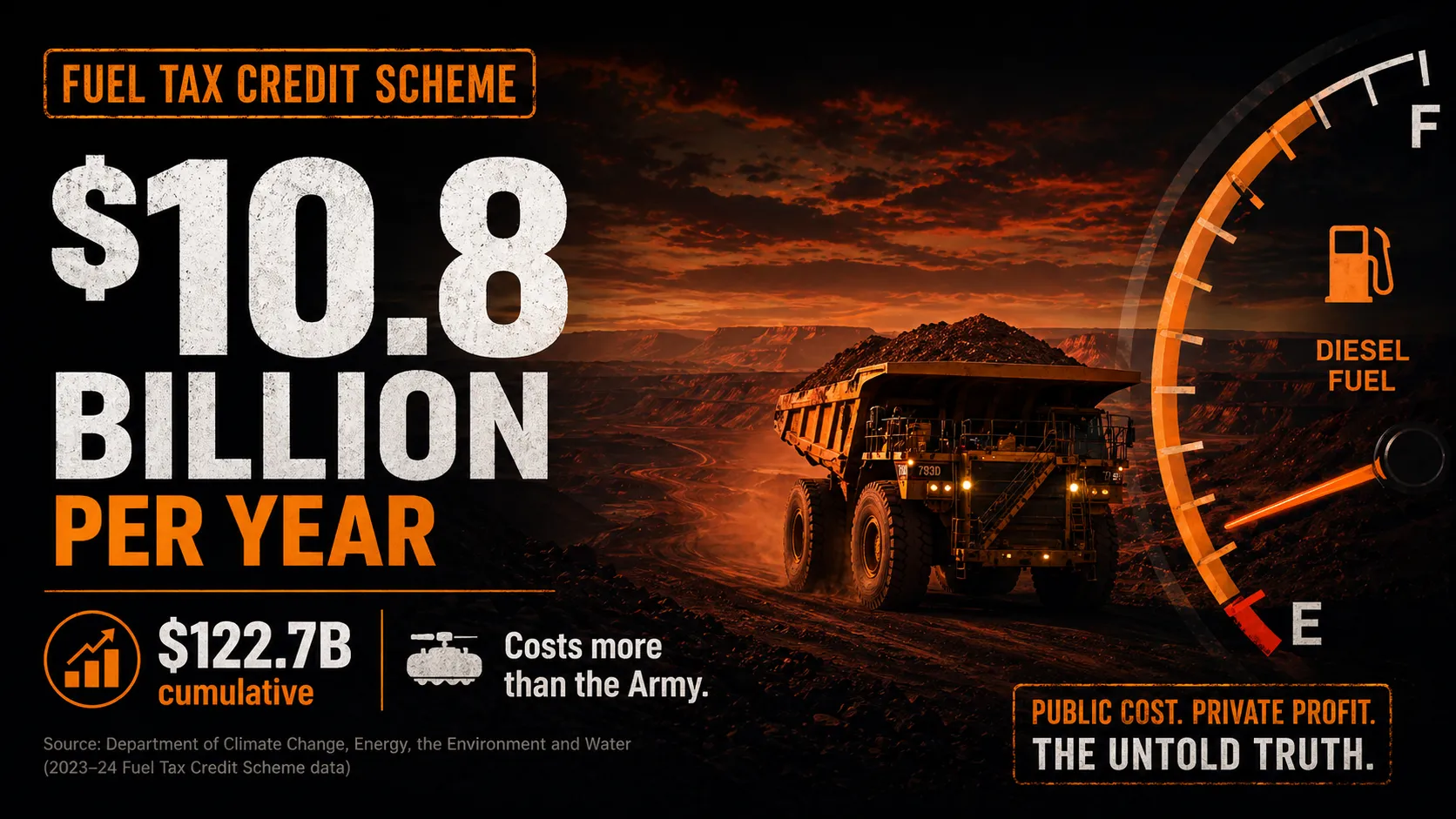
Mining companies get a fuel tax refund. The refund is for diesel used off public roads. The total cost is $10.8 billion a year. Mining takes about half of that. That is roughly $5.4 billion a year. Over 20 years the total hit $122.7 billion. That is more than running the Australian Army. Most big mining companies are foreign-owned. BHP is 73 per cent foreign-owned. Rio Tinto is 95 per cent foreign-owned. So most of the benefit leaves Australia. The government cut the NDIS by $14.4 billion. The diesel rebate grew in the same period. No one in government linked those two numbers publicly. The industry says the refund is fair. Off-road vehicles do not use public roads. The fuel tax pays for road upkeep. But the rebate is growing fast. Some want to cap it for big companies. That could save billions each year.
The Fuel Tax Credit Scheme will cost $10.8 billion this financial year. By 2029, the Treasury projects it will hit $13.1 billion. Mining companies will collect roughly half of it, about $5.4 billion, in diesel rebates. The cumulative total, according to Climate Energy Finance, sits at $122.7 billion.
For context, the Australian Army costs about $7.5 billion a year to run.
How it works
The federal government charges excise on diesel fuel at 50.6 cents per litre. That excise was introduced to fund road construction and maintenance. The logic is straightforward: if you drive on public roads, you pay for their upkeep through fuel tax.
But if you burn diesel off-road - in a mine, on a construction site, in a generator at a remote gas plant - you can claim the excise back. The government refunds it because the fuel was not used on public roads.
Mining companies run haul trucks, excavators, crushers, and generators at sites across the Pilbara, the Bowen Basin, and the Hunter Valley. These machines burn diesel in large volumes. BHP’s iron ore operations in Western Australia alone consume billions of litres a year. Under the scheme, the excise on every one of those litres is refunded.
The numbers
The Australia Institute calculated the annual cost at $10.8 billion for 2025-26. Climate Energy Finance traced the cumulative total to $122.7 billion as of August 2025. Treasury’s own projections show the scheme growing to $13.1 billion by 2028-29.
Mining’s share is roughly 50 per cent. About $5.4 billion a year. Over two decades, the largest miners have claimed an estimated $60 billion in diesel credits.
The Australian Army costs about $7.5 billion a year to run. The diesel rebate costs $3.3 billion more than that.
One executive, one meeting
In February 2026, Kellie Parker, the Australian CEO of Rio Tinto, met with Treasurer Jim Chalmers to discuss the Fuel Tax Credit Scheme. The Australian Financial Review reported the meeting. Rio Tinto did not deny it. Chalmers’ office confirmed the meeting occurred but declined to comment on what was discussed.
The meeting highlights the direct access that major resource companies have to senior government figures. Whether this is appropriate is a matter of debate. Lobbying is legal and common. Resource companies argue they are significant employers and taxpayers, which gives them a legitimate seat at the table.
The foreign ownership question
Eighty-six per cent of Australian mining is foreign-owned, according to Federal Treasury. BHP is 73 per cent foreign-owned. Rio Tinto is 95 per cent foreign-owned. Glencore is over 90 per cent.
When the diesel rebate flows to a mining company, the after-tax profit benefits the shareholder register. For these companies, that means shareholders in New York, London, Beijing, and elsewhere.
This does not mean Australia gets nothing from mining. The industry pays royalties, corporate tax, and employs tens of thousands of people. BHP alone pays roughly 8 per cent of all corporate tax collected in Australia. The question is whether the diesel rebate, on top of those contributions, represents good policy for the public.
Faster than the NDIS
Total fossil fuel subsidies in Australia hit $16.3 billion in 2025-26. The diesel rebate is the largest single line item. And it is growing faster than NDIS spending.
The federal government announced $14.4 billion in NDIS savings. Cuts to participant plans. Tighter eligibility. Reduced funding for supports. The stated reason was fiscal sustainability.
In the same period, the diesel rebate grew by hundreds of millions of dollars. No minister announced a review. No treasurer publicly addressed why a tax concession for off-road diesel was expanding while disability support was being reduced.
The rebate costs $10.8 billion a year. The NDIS cuts target $14.4 billion in savings over the forward estimates. Two numbers in the same budget. One goes up. The other gets cut.
A small business owner in Dubbo pays full excise on the diesel in their delivery van. A mining company in the Pilbara claims the same excise back on diesel in a haul truck that burns 3,000 litres an hour.
Who pays
Every Australian taxpayer funds the rebate indirectly. The excise that gets refunded is revenue the government does not collect. That revenue has to come from somewhere else: personal income tax, the GST, or company tax paid by businesses that do not qualify for a diesel credit.
A small business owner in Dubbo pays full excise on the diesel in their delivery van. A mining company in the Pilbara claims the same excise back on diesel in a haul truck that burns 3,000 litres an hour.
The scheme was designed when diesel was cheaper and mining was a smaller part of the economy. Whether it still fits a sector generating $360 billion a year in revenue is the question now being debated.
The Norway comparison
Norway taxes its petroleum at 78 per cent and built a $1.7 trillion sovereign wealth fund from the revenue. Australia collects more from HECS student loans than from the Petroleum Resource Rent Tax.
The comparison is not exact. Norway’s wealth comes from oil and gas in the North Sea, governed by a different legal and political framework. Australia’s mineral wealth is more diverse - iron ore, coal, lithium, gold - and operates under a federal-state royalty system. But the contrast in policy choices is clear. Norway directed resource revenue into a public fund. Australia maintains a rebate that costs more than its army.
The Other Side
The mining industry makes several arguments in defence of the Fuel Tax Credit Scheme.
First, the rebate exists because off-road vehicles do not use public roads. Fuel excise was designed to fund road maintenance. If a vehicle never touches a public road, the industry argues, there is no reason its operator should pay for one. This is the principle the scheme was built on.
Second, mining companies already pay significant amounts to government. They pay state royalties for the right to extract minerals. They pay corporate tax on profits. BHP alone contributes roughly 8 per cent of all corporate tax collected in Australia. The industry employs over 250,000 people directly and supports many more indirectly in regional communities.
Third, removing or reducing the rebate would increase operating costs. For an industry competing globally for investment capital, higher costs in Australia could mean projects move elsewhere. Countries like Brazil, Canada, and parts of Africa offer competing jurisdictions with different tax and royalty settings.
The Minerals Council of Australia has argued that the rebate is not a subsidy but a mechanism to avoid double-taxing businesses for infrastructure they do not use. Whether this framing is accepted depends on how one defines a subsidy - and that definition is itself contested.
The Way Forward
Several concrete proposals have been put forward to reform the scheme.
Cap the rebate for large companies. The Australia Institute has proposed capping the Fuel Tax Credit for companies with revenue above $1 billion. This would preserve the rebate for farmers, small miners, and regional businesses while limiting the cost to the budget from the largest operators.
Fortescue’s $50 million cap. Fortescue Metals has proposed capping total fuel tax credits at $50 million per company per year. According to estimates, this would affect roughly 18 companies and save approximately $2 billion a year. It is notable that one of Australia’s biggest miners has itself proposed reforming the scheme.
Redirect the savings. The savings from capping the rebate could be directed to a sovereign wealth fund - similar to Norway’s model - or used to fund services like the NDIS. Either way, the revenue would stay in Australia rather than flowing offshore through higher after-tax profits.
Precedent exists. The 2023 reform of the Petroleum Resource Rent Tax (PRRT) showed that resource tax settings can be changed. The PRRT had gone virtually unchanged for decades before the government reformed it. The diesel rebate has a similar history of inertia. The PRRT reform demonstrates that change is politically possible when the numbers are scrutinised.
Sources
- Australia Institute, “Fuel Tax Credit Scheme cost analysis” (March 2026)
- Climate Energy Finance, “Australian fossil fuel subsidies cumulative cost” (August 2025)
- Australian Financial Review, “Rio Tinto CEO lobbies Chalmers on fuel tax credits” (February 2026)
- Federal Treasury, Budget Paper 2: Fuel Tax Credit Scheme projections 2025-26
- ATO, Fuel Tax Credit Scheme eligibility and rates
- Federal Treasury, foreign ownership of Australian mining (cited in Lowy Institute analysis)
- Department of Defence, Australian Army annual budget
- NDIS, “Financial sustainability and savings measures” (2025-26)
Related Investigations
Public Cost, Private Profit / Corporate Tax Avoidance
The Singapore Shuffle
BHP sold Australian iron ore to its own Singapore subsidiary at below-market prices. The subsidiary sold at market rates. Profit booked in Singapore at 0 to 5 per cent tax. Not 30 per cent. BHP settled with the ATO for $529 million. Rio Tinto settled for roughly $1 billion. Chevron lost a Federal Court case over a $2.5 billion intercompany loan at an inflated interest rate. Glencore's ATO audit has been running since 2015. All settlements were made without admission of fault.
Related-Party Debt: How Australia's Gas Industry Shifts Profit Offshore
Australia's gas companies borrow money from their own parent companies at high interest rates. Those interest payments reduce their Australian tax bill to zero in some cases. The Chevron case established that the ATO can challenge these structures. New rules took effect in 2024. The question is whether they go far enough.
Gas, Royalties, and Who Gets What
Australia is one of the world's largest gas exporters. Yet it collects far less in royalties than comparable countries. Qatar earns 33 times more from similar volumes. Here is how the numbers break down.