
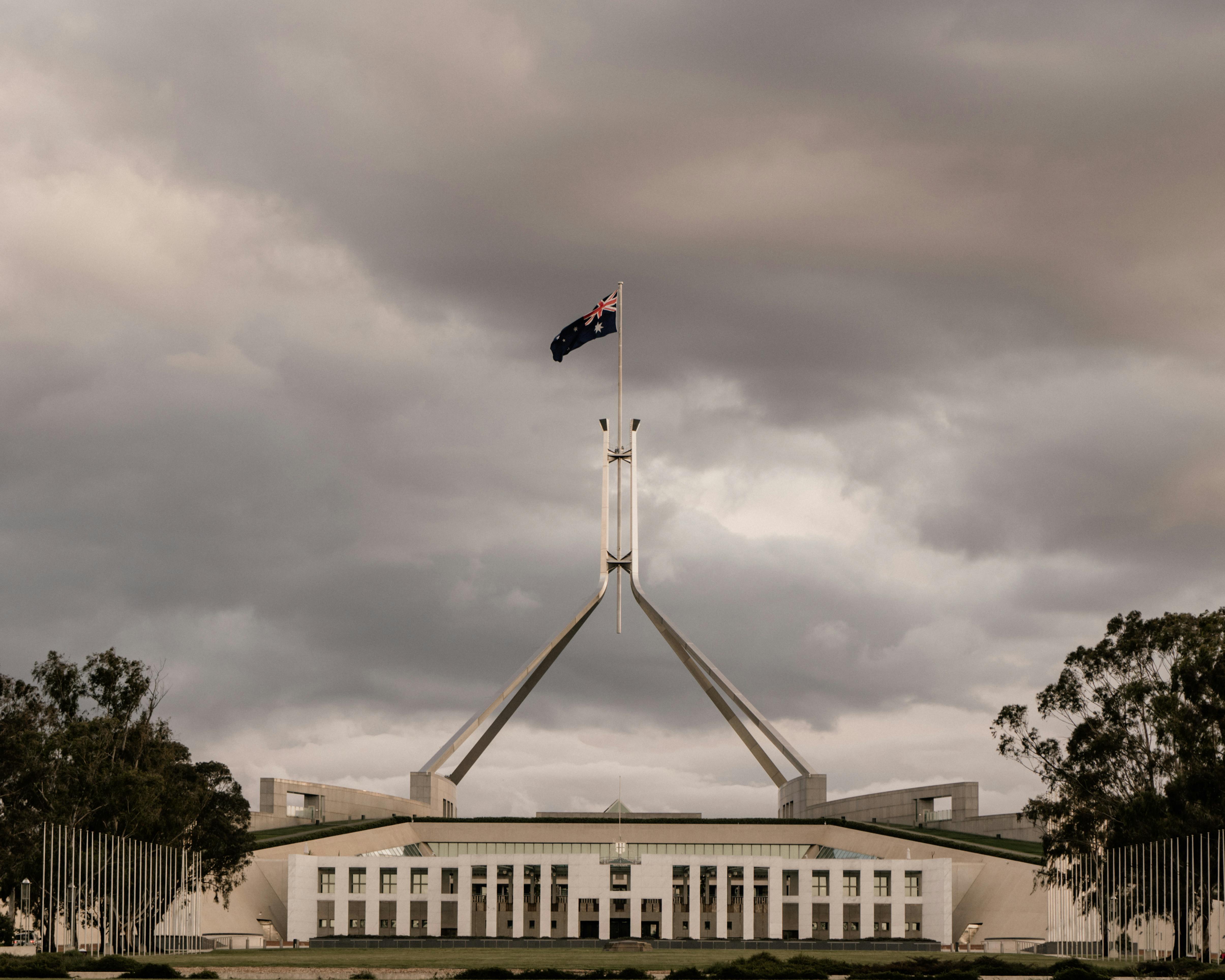
One Nation got $6 million from the government after the 2025 election. They won zero seats in the House of Representatives. The government pays parties for every vote they get. The money goes to the party head office in Brisbane. Not to the candidates. A woman named Jennifer Game ran for One Nation in the Senate. She spent $29,000 of her own money. She says she was never paid back. Pauline Hanson's daughter Lee gets a government salary as a staff member. Hanson charged taxpayers $8,900 for a private plane to a Gina Rinehart event. The party's chief of staff James Ashby was caught on camera asking the American gun lobby for $20 million. The party does not say where the money goes.
At the May 2025 federal election, Pauline Hanson’s One Nation won zero seats in the House of Representatives. The Australian Electoral Commission paid the party $6.08 million anyway.
Every voter’s first choice on the ballot paper earns the chosen party a payment from the AEC. One Nation received $3.38 for each first-preference vote. Michael West Media reported an initial payment of $2.98 million in June 2025. The final total, confirmed by Guardian Australia in April 2026, reached $6.08 million.
Across four federal election cycles, One Nation has banked approximately $13.6 million in AEC public funding. In 2016: $1.7 million. In 2019: $2.84 million. In 2022: $3.0 million. In 2025: $6.08 million.
The money goes to the party. Not to the candidates.
The money flows one way
Here is how the system works. The AEC pays public election funding to the registered political party, calculated at a set rate per first-preference vote. The party then decides what to do with it. Nothing requires the party to share that money with the candidates whose votes earned it. No audit checks whether candidates got reimbursed for campaign costs.
One Nation’s 2024-25 annual return, available on the AEC Transparency Register (the public database where parties must disclose their finances) under Return ID 83227, shows total receipts of $3,323,609 and total payments of $3,326,298. The party also carries debts of $740,532.
On February 3, 2026, Crikey reported that 79% of One Nation’s donations came from undisclosed sources. The highest proportion of any political party in Australia. This is what political finance researchers call dark money: donations below the disclosure threshold that never appear on any public register.
Then there are membership fees. Chief of Staff James Ashby told the Guardian the party was signing up 600 new members per week. Those fees go to Brisbane HQ. The total is not disclosed.
One Nation does not disclose how that money is spent. Nobody outside the party knows where it goes.
The family payroll
On February 26, 2026, Guardian Australia reported that Lee Hanson, Pauline Hanson’s daughter, was employed as a senior adviser to NSW One Nation Senator Rod Roberts. A taxpayer-funded salary. While holding that position, Lee Hanson was simultaneously running as a One Nation Senate candidate in Tasmania.
The same Guardian investigation on March 2, 2026, revealed that Pauline Hanson had claimed multiple taxpayer-funded parliamentary trips around Australia that coincided with One Nation fundraising events.
Three days later, on March 5, the Guardian reported that Hanson billed taxpayers $8,900 for a chartered private plane flight to attend an event honouring Gina Rinehart.
Hanson has not disputed any of these reports.
The man in Brisbane
James Ashby is Pauline Hanson’s chief of staff. He controls One Nation’s day-to-day operations from the party’s Brisbane headquarters. He is the person candidates deal with. And former candidates say he is the person who dismissed their concerns.
In March 2019, Al Jazeera broadcast hidden camera footage of Ashby and then-One Nation MP Steve Dickson meeting with representatives of the American National Rifle Association in Washington DC. The footage showed them discussing a $20 million contribution to One Nation in exchange for weakening Australia’s gun laws. Ashby did not deny the footage. He called the leaks “embarrassing.”
That was not Ashby’s first financial controversy. In May 2017, the ABC obtained secret recordings of Ashby discussing a plan to charge One Nation candidates inflated prices for campaign materials and then invoice the electoral commission. The recordings captured Ashby discussing how to “make some money” from the scheme. Hanson claimed the executive “squashed” the plan. Ashby said the quote was “taken out of context.”
The plan was never implemented, as far as anyone can confirm. But the recordings suggest how the party’s chief of staff may view public electoral funding. As a revenue opportunity.
In October 2023, former One Nation NSW leader Mark Latham used parliamentary privilege - legal protection from defamation suits for statements made in parliament - to allege that Hanson and Ashby operated what he called “the Ashby cash economy.” Latham accused the pair of laundering taxpayer funds through a merchandise operation stored in a Brisbane warehouse, with proceeds flowing back to Ashby and Hanson personally. The Sydney Morning Herald reported the allegations on October 11 and October 13, 2023.
Hanson and Ashby have denied the allegations. No regulatory investigation has been conducted.
On April 9, 2026, One Nation accidentally emailed confidential internal documents to every politician in federal parliament. The incident was reported by 9News. The contents of those documents have not been made public.
The candidates left behind
Jennifer Game was One Nation’s registered officer and South Australian state leader. She ran for the Senate in the 2025 federal election. She told Guardian Australia, in their April 16, 2026 investigation, that she spent $29,000 of her own money on the campaign. She says she was never reimbursed.
After the election, Game says Hanson called her and demanded to know why she had not delivered better results.
Game is not the only former candidate to speak out. On April 13, 2026, ABC News reported that two former One Nation candidates went on the record to say Hanson and Ashby had dismissed their concerns about employing Sean Black as the party’s national campaign director. Black is a convicted rapist. He was jailed for rape in 2018. One Nation hired him anyway.
Hanson only sacked Black in April 2026, after media exposure. In a Sky News interview with Chris Kenny, Hanson admitted she only fired him because of what she called a “political witch hunt.” She blamed “gutter politics” for forcing her hand.
The Victorian branch has its own problems. On April 18, 2026, The Guardian and The Age reported that One Nation’s Victorian president Warren Pickering allegedly told the party’s Nepean byelection candidate to accept campaign donations into a personal bank account rather than an official party account. Hanson called a press conference to deny the reports. Multiple outlets described the press conference as “shambolic.”
Why this matters right now
One Nation’s funding machine is scaling. In March 2026, the South Australian state election delivered One Nation four lower house seats with 22.9% of the statewide vote. The party outpolled the Liberal Party. One seat, Narungga, was won by candidate Chantelle Thomas by a margin of 58 votes. The final parliament: Labor 34, Liberal 5, One Nation 4, Independents 4. One Nation is the effective opposition in South Australia.
The polling trajectory has been steep. In December 2025, Essential put One Nation at 17% primary. By January 2026, Roy Morgan had the party at 21%. In March, Newspoll recorded 27%, an all-time peak. One Nation had overtaken the Coalition on primary votes for the first time. The April slide to 24%, confirmed by both Newspoll and Resolve Strategic, was the first reversal.
The Coalition noticed. On April 14, 2026, Liberal leader Angus Taylor launched the “Australian Values Migration Plan” at the Menzies Research Centre. The plan included mandatory English tests, social media screening of visa applicants including tourists, and a legally binding Australian Values Statement. These positions match One Nation’s published immigration policy almost point for point.
The same day, Taylor announced the Coalition would restrict the 5% first home buyer deposit scheme to Australian citizens only, barring permanent residents. One Nation had introduced a Senate bill to that exact effect on February 4, 2026.
On March 26, the Coalition called for an immediate halving of the federal fuel excise. One Nation had published its “Cut Fuel Excise Now” policy on March 6. Hanson went on Sky News to claim credit. “It was not the Coalition who proposed the fuel excise cut,” she told Chris Kenny on April 1. “It was One Nation first.”
The Guardian’s headline on April 16, 2026, said it plainly: “Anatomy of a policy: how One Nation’s anti-immigration stance on housing became Coalition strategy.”
A party that receives $6 million in public funding and will not say where it goes is now setting the policy agenda for the official opposition. Taylor has even defended preferencing One Nation over independents in the Farrer byelection.
The accountability gap
A party that receives $6 million in public funding and will not say where it goes is now setting the policy agenda for the official opposition.
Nobody in government checks whether candidates see any of the money their votes earned. The AEC publishes party annual returns. But those returns show total receipts, not where the money went. The AEC pays the party. The party has no obligation to distribute it.
Federal electoral finance reforms passed in 2025 introduced spending caps: $800,000 per candidate and $90 million per political party. But the caps do not address the structural problem. The AEC still pays the party, not the candidate.
Neither Labor nor the Coalition want to look too closely. Labor benefits from a divided right-wing vote. The Coalition is negotiating preference deals with One Nation. Neither side has an incentive to scrutinise minor party funding. The gap holds because both majors profit from it.
Seven FOI requests could close some of that gap: AEC election funding payments broken down per candidate; candidate financial disclosure returns cross-referenced against party receipts; Hanson’s complete parliamentary travel expenses; staffing records for Senator Rod Roberts’ office; One Nation’s membership fee structure and revenue; NSW branch financial returns; and the candidate agreements that specify what happens to the AEC funding each candidate’s votes generate.
The gap between what One Nation receives and what its candidates get is the distance between a political party and a machine. Right now, nobody is measuring it.
By the numbers
- AEC public funding received since 2016: $13.6 million
- House of Representatives seats won for that money: 0
- 2025 election AEC payment alone: $6.08 million
- Per-vote rate in 2025: $3.38
- Jennifer Game’s personal campaign spend: $29,000
- Amount reimbursed to Jennifer Game: $0
- Hanson’s private jet to Rinehart event: $8,900 (taxpayer-funded)
- Donations from undisclosed sources: 79%
- Convicted rapists employed as campaign directors: 1
- SA lower house seats won in March 2026: 4
- Narungga winning margin: 58 votes
- Coalition policies matching One Nation (last 6 weeks): 3
- Regulatory bodies examining the candidate-party funding gap: 0
Sources
- Guardian Australia - One Nation Banks Millions in Public Funding
- Michael West Media - AEC Election Funding Report, June 2025
- AEC Transparency Register - One Nation Annual Return
- ABC News - Former Candidates Say Hanson and Ashby Ignored Concerns
- Guardian Australia - Lee Hanson Taxpayer-Funded Role
- Guardian Australia - Hanson’s $8,900 Private Jet
- SMH - Latham Accuses Hanson and Ashby of Financial Impropriety
- Crikey - Dark Money: Major Parties Receive $138M
- ABC News - One Nation Wins Narungga by 58 Votes
- Antony Green - One Nation’s Poll Surge: The First 25 Seats to Watch
- Guardian Australia - Anatomy of a Policy: How One Nation’s Stance Became Coalition Strategy
- ABC News - Hanson Flattered by Coalition Plan
- Saturday Paper - How 291 People Put One Nation in Position to Win
- One Nation - Cut Fuel Excise Now
Related Investigations
Public Cost, Private Profit / Political Capture
The Amplifier
Gina Rinehart's network gave Pauline Hanson a $2.1 million aircraft and $2 million in cash from business associates in April 2026. Every dollar was legal. The Senate voting record shows One Nation voted against higher wages, safety laws, and emissions rules that would cost mining companies money. But they also killed the mining sector's top legislative priority in 2019. The question is not whether Rinehart buys votes. It is whether the legal architecture creates a loop that amplifies political influence in ways voters do not see.
The $10.8 Billion Rebate
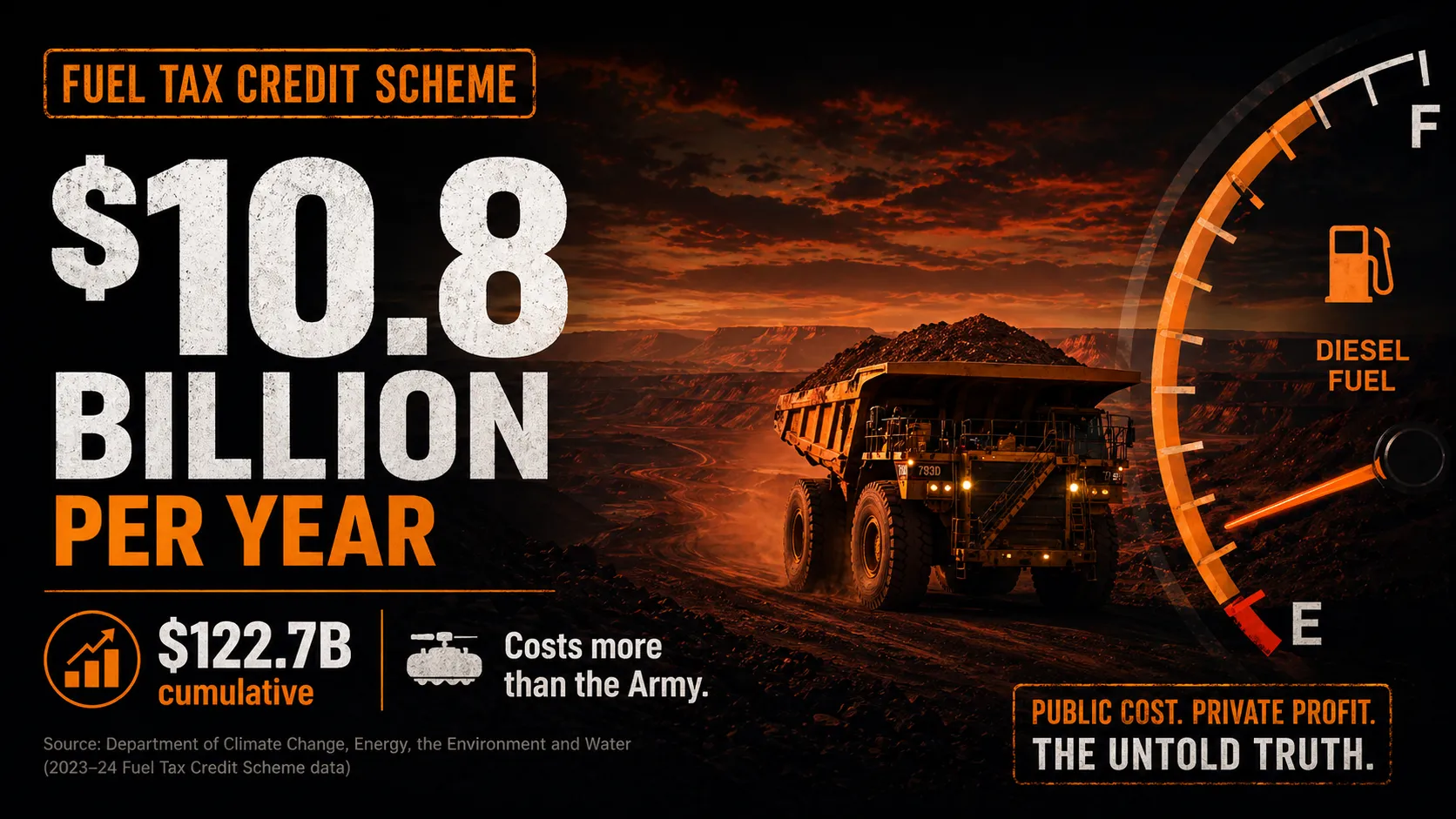
The Fuel Tax Credit Scheme hands back $10.8 billion a year to companies that burn diesel off-road. Mining takes roughly half. The cumulative bill is $122.7 billion. That is more than the Australian Army costs. One Rio Tinto executive lobbied the Treasurer personally to keep it. Eighty-six per cent of Australian mining is foreign-owned. The rebate flows to shareholders overseas. Australians pay foreign companies to dig up their own dirt.

ANZAC Day: Welcome to Country Booed in Four Cities
Welcome to Country ceremonies were booed at dawn services in Melbourne, Sydney, Perth and Adelaide on ANZAC Day 2026. It is the second consecutive year disruptions have occurred, spreading from three cities to four.