
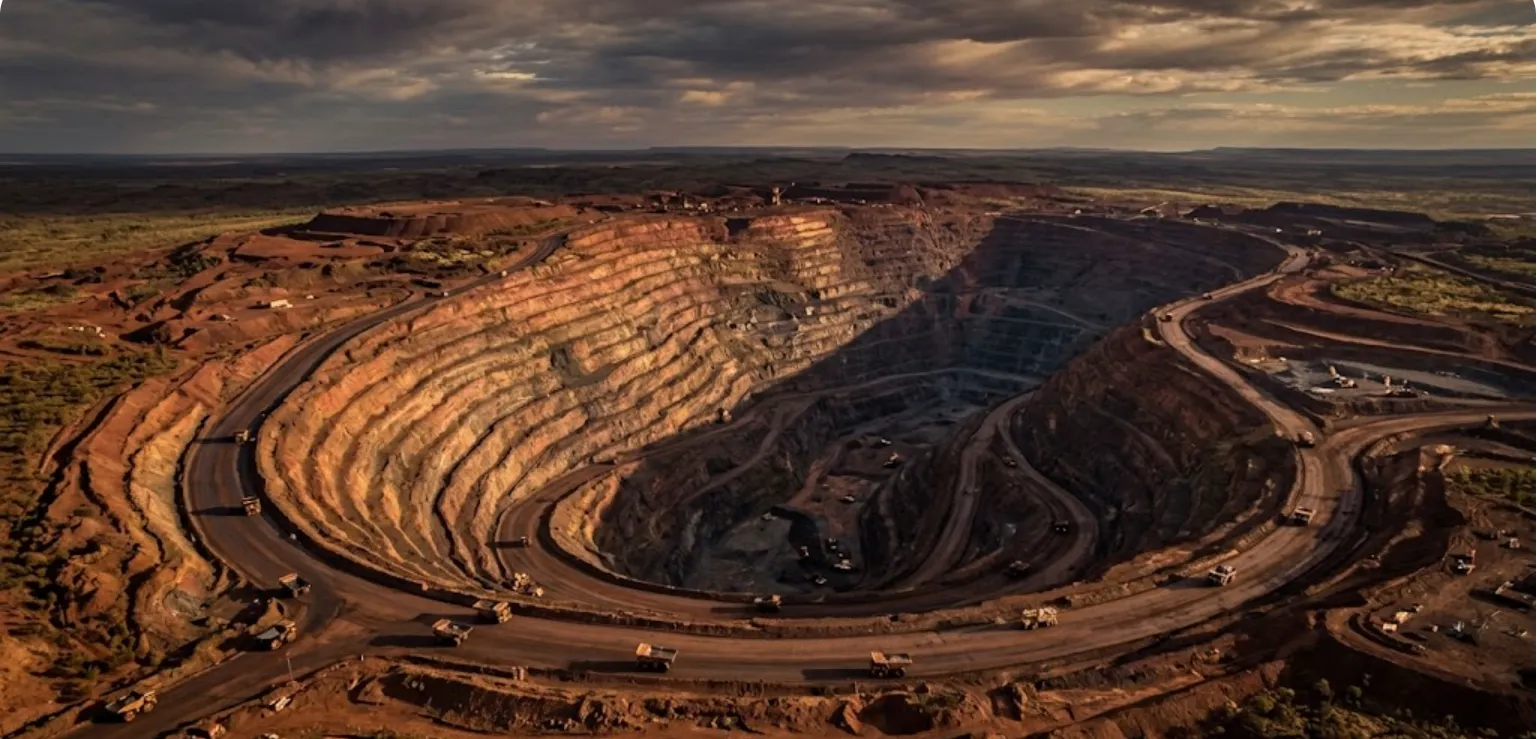
Most of Australia's biggest mining companies are owned overseas. BlackRock, Vanguard, and state-owned Chinese companies hold the largest shares. About 86% of Australian mining is foreign-owned. That number comes from Federal Treasury. The top five miners pulled in over US$360 billion last year. BHP is 73% foreign-owned. Rio Tinto is 95% foreign-owned. Glencore is over 90% foreign-owned. South32 is 60 to 70% foreign-owned. Only Fortescue is mostly Australian. Andrew Forrest owns 35% of it. After tax, most mining profit leaves Australia. But these companies also pay huge tax bills. BHP alone paid A$107 billion to Australian governments over the past decade. Rio Tinto is Australia's largest single corporate taxpayer. The minerals are finite. Once they are gone, the revenue stops. The question is whether Australians get a fair share.
Eighty-six per cent of the Australian mining industry is owned by foreigners. Not Australians. Federal Treasury confirmed the figure. It has been cited in parliamentary inquiries and cross-referenced by the Lowy Institute. Eighty-six cents in every dollar of mining profit, after tax, leaves the country.
This is not a story about whether mining companies pay tax. Some of them pay a lot. BHP pays about 8% of all corporate tax collected in Australia. Rio Tinto is the single largest corporate taxpayer in the country. The question this story asks is simpler. Who owns the companies? Who holds the voting power? And where does the money go after the taxman takes his cut?
The big five
Australia’s top five mining companies by revenue are BHP, Rio Tinto, Fortescue Metals, Glencore, and South32. Together they pulled in more than US$360 billion in revenue last year. They employ tens of thousands of Australians. They dig iron ore, coal, copper, zinc, and nickel out of Australian ground. And most of them are owned by people who have never been here.
BHP: 73% foreign-owned
BHP is domiciled in Australia. Listed on the ASX. Headquartered in Melbourne. It unified its old dual-listed UK structure in January 2022, bringing the whole company under one Australian roof. About 73% of BHP is foreign-owned.
The top of the register tells the story. HSBC Custody Nominees holds 29.66%. JPMorgan Nominees holds another 17.3%. These are not investors. They are custodial banks holding shares on behalf of the real owners: BlackRock at roughly 6.2%, Vanguard at 6.02%, State Street, Fisher Asset Management, Norges Bank. The biggest Australian holder is AustralianSuper at 3.39%.
One share, one vote. No dual-class structure. No Australian controlling interest. The voting power tracks the ownership. Three quarters of it sits offshore.
BHP paid US$11.2 billion to governments globally in FY2024. About 85% of that, roughly US$9.5 billion, stayed in Australia. Over the past decade, BHP has paid A$107.1 billion to Australian governments in tax and royalties. That is real money. It is also money extracted from Australian dirt by a company that is three quarters owned by foreigners.
Rio Tinto: 95% foreign-owned
Rio Tinto has the highest foreign ownership of any major Australian miner. About 95% foreign-owned. Only 5% of shares are held by Australian-domiciled investors.
Rio operates under a Dual Listed Companies structure. Rio Tinto plc is incorporated in England and listed in London. Rio Tinto Limited is incorporated in Australia and listed on the ASX. Same board, same management, same company. But 77.1% of the shares sit on the London Stock Exchange. The Australian listing is a fraction of the total.
The single largest shareholder is Chinalco. The Aluminum Corporation of China. A Chinese state-owned enterprise. It holds 14.55% of Rio Tinto. That stake was acquired in 2008 with FIRB approval, subject to conditions on board representation. A Chinese state company owns the biggest chunk of one of Australia’s biggest taxpayers. Rio’s own CEO said in December 2025 the company was “actively working with Chinalco on shareholding constraints.”
Behind Chinalco: BlackRock at about 9.4%, Vanguard at 3.4%, AustralianSuper at 3.4 to 4.3%. The Australian institutional presence exists but is smaller than the combined foreign positions.
Rio Tinto was Australia’s largest corporate taxpayer in 2023-24. It paid A$6.3 billion in tax on A$52.8 billion in revenue. It paid A$9.5 billion in total taxes and royalties in Australia in 2024 alone. Over the past ten years, 76.4% of its US$82.7 billion in global government payments went to Australia.
Fortescue: 40% foreign-owned
Fortescue is the outlier. About 40% foreign-owned. The lowest of the big five. The reason is Andrew Forrest.
Tattarang Pty Ltd, the Forrest family company, holds 35.12% of Fortescue. That is a dominant, controlling interest. Forrest cannot be outvoted on ordinary resolutions. He holds effective veto power on special resolutions that require 75%. One Australian man controls the strategic direction of Australia’s third-largest miner.
There is a complication. Hunan Valin and Valin Investments, linked to the Hunan provincial government in China, hold about 16% combined. FIRB approved the stake in 2009. Chinese state-linked money sits inside Australia’s most Australian-owned major miner.
Fortescue paid A$6.1 billion in corporate taxes and state royalties in FY2024. Its total global economic contribution was A$27.5 billion that year. Nearly all of it generated in the Pilbara. Income tax rates: 32.6% in FY24, 31.8% in FY23, 30.3% in FY22. Close to the statutory 30% because there is less room for international structuring when the operations and the ownership are both Australian-heavy.
Glencore: 90%+ foreign-owned
Glencore is Swiss-domiciled. Its global revenue was US$230.9 billion in 2024, though that includes commodity trading turnover that inflates the number well beyond mine production. In Australia, it runs 13 coal assets plus copper, zinc, and nickel operations.
The foreign ownership is estimated at over 90%. The company’s structure makes beneficial ownership hard to trace. It is not listed on the ASX. Its ownership runs through commodity trading vehicles and Swiss holding structures.
Glencore paid A$22 billion in taxes and royalties in Australia over the five years to 2023, including A$10.1 billion in corporate income tax. Its Australian royalties actually exceeded its corporate income tax in earlier periods. The state got more than the federal government.
The ATO has been auditing Glencore since at least 2015. The audit concerns billions in claimed losses used to reduce Australian tax. Glencore also fought to suppress documents showing how it moved A$30 billion of Australian revenue offshore. The Federal Court ruled on transfer pricing elements in 2020, with partial wins on both sides.
South32: 60-70% foreign-owned
South32 was spun off from BHP in 2015. Every BHP shareholder got one South32 share for every BHP share they held. It is domiciled in Australia, headquartered in Perth, and listed on the ASX with secondary listings in London and Johannesburg.
About 60 to 70% foreign-owned. No single controlling shareholder. The top holders are State Street at 8.19%, BlackRock at 7.27%, and AustralianSuper at 7.21%. A wider spread than the others. AustralianSuper holds the largest single position on the register, which gives it more relative influence here than at BHP or Rio.
South32 paid US$4.4 billion in corporate income tax and US$2.85 billion in royalties over the past decade. FY24 income tax was US$223 million. The effective rate sits at 36 to 39%, including royalties. The company has taken statutory losses in some years, which reduces the headline number.
The Big Three
BlackRock, Vanguard, and State Street appear in the top holders of every single one of these companies. They are passive index funds. They do not pick stocks. They buy everything in the index and hold it. But they vote.
Across the five miners, the Big Three collectively hold between 13% and 33% of each company. At Newmont, which acquired Newcrest in 2023 and now controls Australia’s largest gold operations, the Big Three hold about 33%. At BHP, about 13%. At Rio Tinto, about 14%. At South32, about 19%.
These are American companies. BlackRock is headquartered in New York. Vanguard is in Malvern, Pennsylvania. State Street is in Boston. They manage retirement savings from all over the world, including Australian super funds. But the voting decisions are made in the United States. The governance votes. The director nominations. The remuneration reports. All of it.
The Chinese state stakes
Two of the five top miners have Chinese state-linked shareholdings. Chinalco holds 14.55% of Rio Tinto. Hunan Valin holds about 16% of Fortescue. Both were approved by FIRB with conditions.
The combined Chinese state-linked holding across these two companies is roughly 30% of two of Australia’s five largest miners. The Australian government approved every dollar of it.
Where the money goes
After tax, after royalties, the profit that remains belongs to shareholders. At 86% foreign ownership, 86 cents in every dollar of after-tax profit flows offshore. To Houston, London, New York, Singapore, Beijing. To BlackRock’s clients. To Vanguard’s unitholders. To Chinalco’s state treasury.
BHP paid about 8% of all corporate tax in Australia. Rio Tinto paid the most of any single company. The mining sector paid roughly 50% of all large corporate income tax in 2023-24, according to the ATO. These are big numbers. They fund real things.
But the minerals are non-renewable. Once they are gone, the revenue stops. The question is not whether Australia gets a cut. It does. The question is whether the cut is fair for something that cannot be replaced, extracted from public land by companies that are mostly owned by people who do not live here.
The Newcrest deal
In November 2023, Newmont Corporation acquired Newcrest Mining for $26.2 billion. Newcrest was Australia’s largest gold miner. It was ASX-listed, Australian-domiciled, and ran Boddington, Cadia, and Telfer, three of the country’s biggest gold operations.
Newmont is incorporated in Delaware. Headquartered in Denver. Listed on the NYSE. The acquisition transferred ownership of Australia’s largest gold mining operations from an Australian company to an American one. Former Newcrest shareholders got Newmont stock and became minority holders in a US company.
The Big Three index funds now hold about 33% of Newmont. Vanguard alone holds 12.42%. BlackRock holds another 16% across its vehicles. The board is 75% American. Two Australians sit on it.
This is how ownership shifts. Not through a dramatic expropriation. Through a boardroom deal that transfers Australian assets into a Delaware-incorporated company, listed in New York, controlled by index funds in Boston and Pennsylvania.
The other side
After tax, after royalties, the profit that remains belongs to shareholders. At 86% foreign ownership, 86 cents in every dollar of after-tax profit flows offshore.
The foreign ownership picture is striking, but it is not the full story. Foreign capital developed Australian mining because domestic capital was not sufficient to fund it. In the 1960s and 1970s, when the Pilbara iron ore industry was being built, Australian capital markets were too small to finance multi-billion-dollar mine and rail projects. Japanese, American, and British investment made the industry possible. Without it, many of the mines that employ tens of thousands of Australians today would not exist.
The trade-off was deliberate policy, not an accident. successive Australian governments chose to attract foreign investment rather than nationalise the resource sector. The result is an industry that generates enormous tax revenue. BHP alone has paid A$107.1 billion to Australian governments over the past decade. The mining sector contributes roughly half of all large corporate income tax collected. That money funds hospitals, schools, and infrastructure.
Australians also benefit through their retirement savings. Australian superannuation funds hold significant stakes in these companies. AustralianSuper holds 3.39% of BHP, up to 4.3% of Rio Tinto, and 7.21% of South32, the largest single position on that register. Every Australian worker with a super account has exposure to mining profits flowing back into their retirement savings.
The comparison to Norway is common but imperfect. Norway’s Government Pension Fund Global holds over US$1.7 trillion. But Norway has 5.4 million people sitting on massive North Sea oil reserves discovered late, in deep water, with a very high ratio of resource wealth per capita. Australia has 27 million people, a much larger landmass, and a more diverse resource base spread across dozens of commodities and hundreds of deposits. The same sovereign wealth model does not translate directly. Norway also nationalised through Statoil, a path Australia deliberately chose not to take.
The way forward
Australia does not need to nationalise its mines to capture more value from its non-renewable resources. Several policy options are available that preserve private ownership while increasing the public share.
Resource rent taxes with enforceable design. The 2012 Minerals Resource Rent Tax failed in part because of design flaws and generous deductions. A revised resource rent tax, modelled on the original PRRT that still applies to offshore petroleum, could capture a share of super-profits when commodity prices spike. The key is drafting it with fewer loopholes than the MRRT had.
Higher royalties, especially on iron ore. Western Australia’s iron ore royalty rate sits at 7.5% for fines ore. This rate has not kept pace with the surge in prices over the past two decades. An increase to 10% or higher, phased in over several years, would give the state a larger share without threatening project viability at current prices.
Australian equity thresholds for new projects. The Foreign Investment Review Board already reviews major mining acquisitions. FIRB could impose minimum Australian equity requirements as a condition of approval for new mining projects or expansions above a certain threshold. This would gradually increase domestic ownership over time without disrupting existing operations.
Incentivise super fund investment. Australian superannuation funds manage over A$3.8 trillion. Policy changes, such as tax incentives or mandated allocation floors for domestic resource equities, could encourage funds to build larger direct stakes in Australian miners. More Australian ownership means more voting power and more profit staying in the country.
Expand the Future Fund with resource revenue. The Future Fund exists but is not specifically capitalised from resource royalties. Australia could ring-fence a portion of mining royalties and resource rent taxes into a dedicated sovereign wealth vehicle, building a permanent asset base that outlasts the minerals themselves.
These are choices. They require political will. The current system generates substantial revenue, and any change will face resistance from the companies that operate within it. But the minerals are finite. The decisions made now will determine what Australians have left when the ground is empty.
Sources
- BHP Economic Contribution Report 2024
- BHP Economic Contribution Report 2025
- Rio Tinto Press Release: Taxes and Royalties Paid 2024 (27 Mar 2025)
- Rio Tinto Taxes and Royalties Paid Report 2024
- South32 Tax Transparency Report 2025
- Glencore Australia Voluntary Tax Transparency Report 2023
- ATO Corporate Tax Transparency Report 2023-24
- AFR, “Revealed: The companies paying the most and least tax” (2 Oct 2025)
- Australia Institute, “Undermining Our Democracy” (2017)
- UNSW, “Worried about agents of foreign influence? Just look at who owns…” (2019)
- Reuters, “Rio Tinto-Chinalco shareholding discussions” (Dec 2025)
- Newmont 2024 Taxes and Royalties Contribution Report
- Fortescue FY24 Results Announcement
Related Investigations
Public Cost, Private Profit
The $10.8 Billion Rebate
The Fuel Tax Credit Scheme hands back $10.8 billion a year to companies that burn diesel off-road. Mining takes roughly half. The cumulative bill is $122.7 billion. That is more than the Australian Army costs. One Rio Tinto executive lobbied the Treasurer personally to keep it. Eighty-six per cent of Australian mining is foreign-owned. The rebate flows to shareholders overseas. Australians pay foreign companies to dig up their own dirt.
The Singapore Shuffle
BHP sold Australian iron ore to its own Singapore subsidiary at below-market prices. The subsidiary sold at market rates. Profit booked in Singapore at 0 to 5 per cent tax. Not 30 per cent. BHP settled with the ATO for $529 million. Rio Tinto settled for roughly $1 billion. Chevron lost a Federal Court case over a $2.5 billion intercompany loan at an inflated interest rate. Glencore's ATO audit has been running since 2015. All settlements were made without admission of fault.

Related-Party Debt: How Australia's Gas Industry Shifts Profit Offshore
Australia's gas companies borrow money from their own parent companies at high interest rates. Those interest payments reduce their Australian tax bill to zero in some cases. The Chevron case established that the ATO can challenge these structures. New rules took effect in 2024. The question is whether they go far enough.