
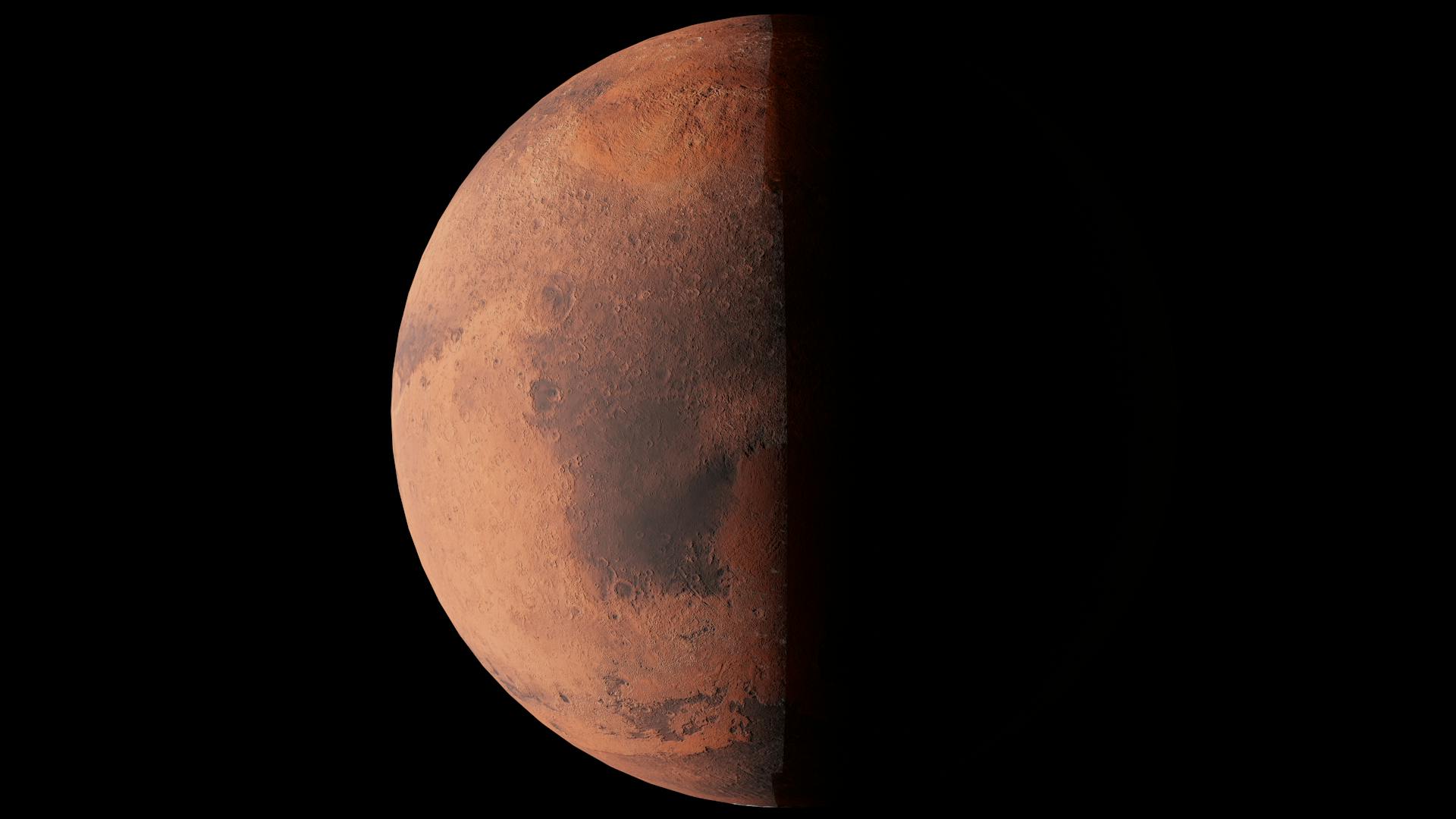
In 2018, scientists said they found liquid water under the ice at Mars' south pole. It was huge news. Headlines everywhere. Seven years later, newer data says the signal was probably not water at all. It might be layers of ice and dust. Or clay. The instruments that made the original claim were not precise enough to tell the difference. When the discovery was announced, it was front page news. When the correction came, almost nobody noticed.
On 25 July 2018, a team of Italian scientists published a paper in Science. They claimed to have detected a stable body of liquid water beneath the south polar ice cap of Mars. The instrument was MARSIS, a radar sounder on the European Space Agency’s Mars Express orbiter. The signal showed a bright reflection 1.5 kilometres below the surface, at a region called Ultimi Scopuli. Roberto Orosei of the National Institute of Astrophysics in Bologna led the team. He said the most likely explanation was a briny lake. (Source: Orosei et al., “Radar Evidence of Subglacial Liquid Water on Mars,” Science, July 2018)
The headlines wrote themselves. “Water on Mars.” “Lake Found on Mars.” Wired called it a finding that “raises tantalizing questions about the planet’s geology.” The BBC ran it as their lead science story. Present-day liquid water meant present-day life was possible. The story went everywhere.
What happened next received considerably less attention.
How the claim worked
MARSIS sends radar pulses through the Martian surface and measures what bounces back. Different materials produce different reflection strengths. Liquid water, in theory, produces a stronger reflection than rock or ice. That was the basis of the claim.
The detection sat at Ultimi Scopuli, an area near Mars’ south pole covered by layered deposits of ice and dust. The bright reflection covered roughly 20 kilometres. The research team acknowledged the water would need to be extremely salty to stay liquid at Martian temperatures, which drop well below freezing. But the signal, they argued, was consistent with a body of liquid water. (Source: Orosei et al., Science, 2018)
The paper passed peer review. It was published in one of the world’s top journals. The claim had weight.
Two years later, the doubts arrived
In 2021, Khuller and Plaut published a paper in Geophysical Research Letters showing that similar bright reflections existed across much more of the Martian polar cap than the Orosei team had reported. If every bright reflection meant liquid water, Mars had far more of it than anyone expected. That was unlikely. Other materials could produce the same effect. (Source: Khuller and Plaut, Geophysical Research Letters, 2021)
Then 2022 brought a Nature Communications paper analysing signal attenuation. The reflections were consistent with unusual materials, the researchers found, but did not require liquid water. Clays, salty ice, or other conductive minerals could produce similar signals. (Source: Nature Communications, September 2022)
The biggest challenge came in June 2024. A paper in Science Advances by Lalich and colleagues showed that small variations in ice composition and layer thickness could produce exactly the same bright reflections that MARSIS detected. No liquid water required. (Source: Science Advances, June 2024)
The walkback was now in the peer-reviewed literature. It had not yet made the front pages.
New radar, fainter signal
November 2025. The case weakened again.
A study using higher-frequency radar found only a faint signal where MARSIS had detected its bright reflection. The newer instrument, which provides better resolution, did not see what MARSIS saw. The Planetary Science Institute put it bluntly: “New observations suggest Mars’ south pole lacks lake beneath the ice.” (Source: AGU, November 2025; PSI blog, November 25, 2025)
Universe Today covered it in December under the headline “New Radar Data Dries Up Hope For Subsurface Liquid Water On Mars.” The 2018 discovery had “probably” not been water at all. A Springer review paper the same month acknowledged MARSIS had provided “the first evidence of a stable body of liquid brine” but also noted the ongoing debate. (Source: Universe Today, December 2025; Springer, December 2025)
What changed
The bright reflection is real. What causes it is not settled. Layered ice, clays, briny sediments, or some combination. The liquid water explanation, while not definitively ruled out, is no longer the front runner.
The 2018 announcement was not reckless. The paper was honest about its limitations. But the gap between what the paper said and what the headlines said was enormous. The paper said “the radar evidence is consistent with liquid water.” The headlines said “water found on Mars.” Those are different claims.
A scientific paper makes a careful claim with caveats. Press releases simplify. Headlines simplify further. The correction, when it comes, is published in the same journals with the same caveats. But the press releases are quieter. The headlines are smaller.
The paper said “the radar evidence is consistent with liquid water.” The headlines said “water found on Mars.” Those are different claims.
The attention gap
The discovery received global coverage. The correction, arriving in instalments over seven years, received specialist coverage at best.
“Water on Mars” is a headline. “Actually, probably not water on Mars” is not. Scientists involved in the rebuttal papers have noted this asymmetry.
Mars Express continues to orbit. New data keeps arriving. The debate is not over. But if the original claim is eventually retracted, that retraction will not reach the same audience as the announcement.
The 2018 paper has been widely cited. The 2024 rebuttal has been cited far fewer times. The citation gap mirrors the attention gap. That is the pattern. It is not hidden.
Sources
- Orosei et al., “Radar Evidence of Subglacial Liquid Water on Mars,” Science, 2018
- Wired, “Scientists Discover Evidence of the First Large Body of Liquid Water on Mars,” July 2018
- Khuller and Plaut, GRL, 2021
- Nature Communications, MARSIS signal attenuation, September 2022
- Science Advances, ice composition explains reflections, June 2024
- AGU, high-frequency radar perspective, November 2025
- PSI blog, “New observations suggest Mars south pole lacks lake,” November 2025
- Universe Today, “New Radar Data Dries Up Hope,” December 2025
- Springer, “Water Ice in the Subsurface and Polar Caps of Mars,” December 2025
Related Investigations
Media Narrative Accountability
Three Authorities, Three Stories, Your Mortgage
The Treasurer told Parliament government spending played no role in rate rises. The RBA Governor said the opposite. Your mortgage is caught in the middle.

The WHCD Manifesto vs. What You Were Told
The White House said the shooter was anti-Christian. His manifesto suggests otherwise. He was not a registered Democrat. This is the third attack, not the fourth. Three claims, checked against the document.

The $1,500 Assassination Attempt: How a Tutor Got Within Firing Range of the President
A part-time tutor with zero criminal record spent $1,500 over two and a half years. He bought guns legally in California. He traveled cross-country by train. He checked into the hotel as a guest. He got within firing range of the President of the United States.