
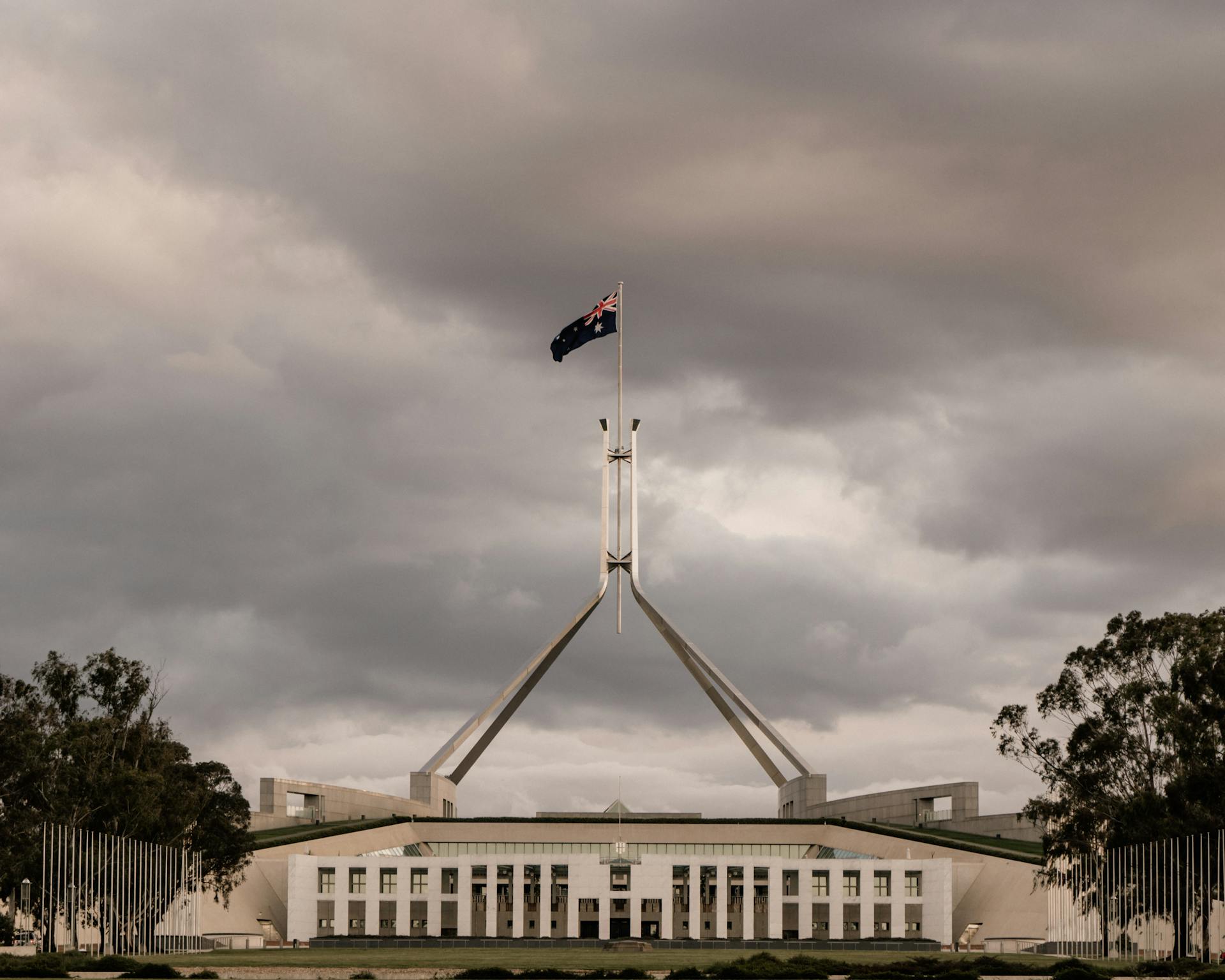
The government spends $785 billion a year. The RBA says some of that spending pushes prices up. The Treasurer says it doesn't. Inflation hit 4.6% in March. That's the highest in three years. The RBA has already put interest rates up twice. There's an 85% chance they do it again on May 5. If they do, the average mortgage goes up another $116 a month. That's on top of the two hikes already done. 1.3 million mortgage holders are at risk. The Treasurer told Parliament spending had no role. The RBA Governor said it did. A Treasury official agreed with the RBA. Three authorities. Three different answers. One of them is the outlier.
On February 3, 2026, Treasurer Jim Chalmers stood in the House of Representatives and told Parliament that government spending “played no role” in the Reserve Bank’s decision to raise the cash rate that same day.
Two days later, RBA Governor Michele Bullock told a parliamentary committee the opposite. “Government spending is part of total spending and total aggregate demand in the economy,” she said. It was “contributing to inflationary pressures.”
Australians have heard a treasurer sever the link between fiscal policy and interest rates before. The claim has a history. And the institutional framework that governs the relationship between government spending and the cash rate was built on the understanding that the two are connected.
The precedent
In the early 1970s, the Whitlam government expanded federal spending on health, education, and urban development. Inflation, already rising due to global oil shocks and domestic wage pressures, accelerated sharply. By 1975, consumer prices were rising at more than 15 per cent a year. The Reserve Bank raised rates. Treasury officials counselled spending restraint. The connection between fiscal expansion and price pressure was not contested within the institutional apparatus. It was understood.
The lesson shaped the next two decades. When the Hawke government took office in 1983, Treasurer Paul Keating negotiated the Prices and Incomes Accord with the Australian Council of Trade Unions. The deal was a demand-management arrangement. Unions restrained wage claims. The government restrained its own spending to reduce inflationary pressure. Fiscal policy and monetary policy moved in the same direction. By design.
A decade later, in 1993, the Reserve Bank under governor Bernie Fraser formally adopted an inflation-targeting regime. The target band: 2 to 3 per cent, on average, over the cycle. The framework meant that if government spending pushed aggregate demand high enough to threaten that target, the RBA would respond with rate rises. This was not a partisan position. It was the architecture of Australian macroeconomic management.
Three years after that, in August 1996, Treasurer Peter Costello and RBA governor Ian Macfarlane signed the first Statement on the Conduct of Monetary Policy. The document formalised the bank’s operational independence. It also acknowledged that fiscal policy could affect the RBA’s ability to meet its inflation target. The framework has been maintained by every government since.
What connects these episodes is a principle built into Australian institutional arrangements since 1983. Government spending affects aggregate demand. Aggregate demand affects inflation. An independent central bank sets interest rates to keep inflation within its target band. When a treasurer says government spending played no role in a rate decision, they are not disagreeing with a political opponent. They are disagreeing with the framework their own government operates within.
The numbers
Headline CPI hit 4.6 per cent in the year to March 2026. Highest since September 2023. The trimmed mean, which strips out volatile items, held at 3.3 per cent. The gap tells you where the pressure is coming from. Housing up 6.5 per cent. Transport up 8.9 per cent. And the expiration of $1.8 billion in energy rebates that had been artificially suppressing electricity costs.
Strip out the rebate cliff and real CPI lands somewhere around 4.0 to 4.2 per cent. Still above the RBA’s 2 to 3 per cent target. Still a problem. But less dramatic than the headline figure politicians were trading across the dispatch box.
The transport number is the one to watch. Fuel prices surged after the Strait of Hormuz, one of the world’s most important energy chokepoints, became a conflict zone. This is a supply shock. Rate hikes cannot fix supply shocks. They can only crush demand hard enough to compensate.
The budget
The 2025-26 federal budget ran $785.7 billion in expenses against $743.6 billion in revenue. Underlying cash deficit: $42.1 billion, or 1.5 per cent of GDP. Forward estimates projected cumulative deficits of $179.5 billion over five years, according to budget papers. The centrepiece was a $17 billion tax cut package. $7.9 billion over four years for health and Medicare. $1.8 billion in energy rebates, set to expire before the March CPI spike. $800 million to expand Help to Buy. $135.7 billion over four years for education, most of it baseline continuation rather than new money.
The Parliamentary Budget Office picked through the $57 billion gap between the March 2025 budget and the December 2025 Mid-Year Economic and Fiscal Outlook (MYEFO). Two-thirds of that gap came from spending increases. Not falling commodity prices. Not changed economic parameters. Spending.
Independent economist Chris Richardson put a rough number on it: every $7 billion in extra government spending would force the RBA to lift the cash rate by 25 basis points to offset the inflationary effect.
Not everyone agreed. Stephen Koukoulas, a former Gillard government advisor, called the budget “close to pitch perfect.” Bullock herself refused to lay sole blame on fiscal policy. “Government spending is not the only thing driving inflation higher,” she told the ABC.
She was right. It was not the only thing. But that is not what Chalmers said. He said it played no role.
The contradiction
On February 3, the RBA hiked the cash rate 25 basis points to 3.85 per cent. In Parliament that day, Chalmers told the House of Representatives that government spending “played no role” in the decision.
February 5 and 6. Bullock fronted a parliamentary committee. Under questioning she said government spending was “contributing to inflationary pressures.”
February 11. A senior Treasury official told Senate estimates that spending increases were a significant factor in the budget blowout.
February 15. Chalmers told Parliament again that “government spending played no role in the decision to raise interest rates.”
Bullock had already said the opposite. A Treasury official had already contradicted the Treasurer’s framing. And Chalmers said it again.
Three authorities. Three different accounts of the same fiscal reality. The Treasurer was the outlier.
What it costs
The March rate hike pushed the cash rate to 4.10 per cent. It was a 5-4 split decision at the RBA board. One vote either way and it would have been a hold.
Each 25 basis point hike adds roughly $116 to $120 a month to the average Australian mortgage of $736,257. Roy Morgan’s March survey found 26.8 per cent of mortgage holders were “at risk.” That is roughly 1.32 million Australians. 380,000 more than when the RBA started raising rates in May 2022.
Consumer spending fell in February for the first time in 17 months. Confidence dropped at a speed comparable to early COVID. Businesses were already hurting. 14,722 companies entered external administration in 2024-25, the highest figure since 1999, according to ASIC data published by the Australian Financial Security Authority.
The honest framing
The budget did not cause inflation. That claim is too strong. The trimmed mean at 3.3 per cent versus headline at 4.6 per cent tells you this was a supply-driven spike. Energy costs. Fuel. The Hormuz shock. Things rate hikes cannot fix, only compensate for.
But government spending created a demand floor that left Australia more exposed to that shock than it needed to be. Australia was the first major advanced economy to resume hiking in 2026. The US, UK, Canada and New Zealand were all holding or cutting. The IMF told Chalmers directly: “don’t fuel war inflation.”
The RBA’s independence was designed for moments like this. When political incentives push a treasurer toward spending, the central bank’s job is to name the economic consequences. Bullock did that. Chalmers said she did not.
On May 5, the RBA board meets again. Markets put the chance of another hike at 85 per cent. If it comes, another $116 a month on the average mortgage.
The Statement on the Conduct of Monetary Policy acknowledges the connection between fiscal and monetary policy. So did the RBA Governor. So did a senior Treasury official. The Treasurer was the one who said otherwise.
Sources
- ABS: CPI rose 4.6% year to March 2026
- ASX Rate Tracker: 85% probability of May 5 hike
- RBA cash rate target
- Budget overview 2025-26
- AFR: Bullock testimony, Feb 6 2026
- SMH: IMF warning to Chalmers, Apr 14 2026
- Roy Morgan: Mortgage stress risk, Mar 2026
- Compare the Market: Rate hike repayment impact
- Stocks Down Under: CPI analysis, Apr 29 2026
- ABC: Monthly inflation surges, Apr 29 2026
- AFSA: State of the Personal Insolvency System 2024-25
Related Investigations
Media Narrative Accountability / Fiscal-Monetary Conflict
Record Margins, Record Prices, Taxpayer Backing
Australia's two remaining refineries quadrupled their margins in twelve months while consumers paid record fuel prices. The government responded by underwriting private fuel imports with public money. Then, on the same day it announced 200 million litres of extra diesel, it told 160,000 disabled Australians their support was ending.

190,000 Households Wait for Public Housing. 370 Homes Were Delivered.
190,000 households wait for public housing. The government promised 40,000 homes and delivered 370. Property investor tax breaks will cost $247 billion.
The WHCD Manifesto vs. What You Were Told
The White House said the shooter was anti-Christian. His manifesto suggests otherwise. He was not a registered Democrat. This is the third attack, not the fourth. Three claims, checked against the document.